
What is a ponzi scheme? Wikipedia terms as " fraudulent investment operation that pays returns to its investors from their own money or the money paid by subsequent investors, rather than from any actual profit earned by the individual or organization running the operation."
In simple words " Its like robbing paul to pay peter". This scheme works till you get enough money from new contributions to pay old contributions. The day that is exhausted, its bust.
Now lets look at current debt crisis.
I have seen such kind of situation in small mircofinance entities, particularly called as co-operative credit societies. In such institution, you will always find that their loan recovery rate is almost 100%. The truth is nowhere near it. These institutions have their books window dressed to appear clean.
The mechanism works like this:
Now lets look at current debt crisis.
- European Banks have lent enormous funds to countries like Greece, Italy, Portugal & Spain. (but then that is normal practice. All governments do that)
- If government runs surplus budgets, they reduce debts. (but then someone raises questions, doesn't government have efficient use of resources(read surplus) other than paying back debt?). So governments runs deficits. (blame J M Keynes to a certain level for this)
- To cover the deficits, governments borrow more money.
- Now this works fine till we have primary surplus that is interest is less than borrowings. If that is breached, then you borrow to pay interest. (In corporate lingo, you need to have Debt Service Coverage Ratio of 1 or more)
I have seen such kind of situation in small mircofinance entities, particularly called as co-operative credit societies. In such institution, you will always find that their loan recovery rate is almost 100%. The truth is nowhere near it. These institutions have their books window dressed to appear clean.
The mechanism works like this:
- A microfinance institution, MFIN issues loan of 10,000 to Pawan. The interest rate is 2% per month, which translates to 240 in a year. the tenure of loan is one year
- At the close of year, Pawan says, he is unable to pay. Now, the MFIN does not want to show any NPA (Non-Performing Asset).
- So they work out scheme saying, Pawan paid 10,240 along with interest on last day of financial year.
- MFIN issues new loan to 10,240 on the first day of new financial year or last day of current financial year.
- Now this happens only in books, there is no actual money changes hands.
- The books represent 100% recovery. Balance Sheet is good.
- Income(I) which should have been reduced by non-recoverable 10,000 would reflect (I-10,000) now actually represents no losses and income of 240 i.e (I+240).
- What is the amount of mis-apprpriation - [(I+240)-(I-10,000)] = -10,240.
- What happens, if the is revealed or caught? criminal proceedings for fraud, misappropriation.
Now lets look at Debt Crisis: 
1) PIGS is running deficit of mammoth proportions.
2) ECB, IMF suggest we should have EFSF (European Financial Stability Fund). The corpus was recently raised to 440 Billion Euro.
3) How are they gonna use it? Leverage the fund to generate the resources of 1.7 Trillion Euro and lend to nations with debt crisis to help repay debt.
4) So the banks, which will get repaid will be eager to subscribe these new bonds issued by EFSF, so that their existing loans get repaid and no losses are booked.
Does that not sound like the Microfinance institution explained above? Yes, only that was at a scale of 10,000 this is magnified by ratio to 1000 times.
So the misappropriation of profits, funds, mis-representation is of huge mammoth scale. and what happens because of this action? Markets rebound, feel confident of overcoming the crisis. reward the parliamentarians who perpetrated this fraud?
The crisis in the first place was because the Governments leveraged their future earnings by having fiscal deficit (deficit financing as called by Keynes). Keynes said, We are dead in long term. so look for short term solutions. So he said, if the economy is not growing, borrow money and spend it in the economy, which due to money multiplier effect grow the economy in multiples of spend and eventually recover that cost incurred from future tax income.
This is nothing but leveraging your future income(cash flow) with current borrowing with expectation that this will be cancelled out.
This theory was fine. Many countries implemented too. Deficits were norm of the day. Only people forgot was this was solution for short term. When that short term ended and long term started nobody cared. Everybody turned the keynes on his head... to cover one deficit another big borrowing program created. to cover that borrowing, still larger borrowing program created...
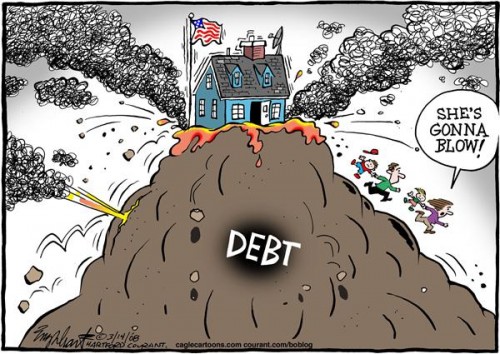
This works only till you are able to generate future income to compensate for the losses of current borrowings. What happens after that? Then everything crashes..
Are we in this mode now? or there is still steam left to leverage more? and how long will we able to keep on leveraging our assets?
Is somebody asking these questions?
1) PIGS is running deficit of mammoth proportions.
2) ECB, IMF suggest we should have EFSF (European Financial Stability Fund). The corpus was recently raised to 440 Billion Euro.
3) How are they gonna use it? Leverage the fund to generate the resources of 1.7 Trillion Euro and lend to nations with debt crisis to help repay debt.
4) So the banks, which will get repaid will be eager to subscribe these new bonds issued by EFSF, so that their existing loans get repaid and no losses are booked.
Does that not sound like the Microfinance institution explained above? Yes, only that was at a scale of 10,000 this is magnified by ratio to 1000 times.
So the misappropriation of profits, funds, mis-representation is of huge mammoth scale. and what happens because of this action? Markets rebound, feel confident of overcoming the crisis. reward the parliamentarians who perpetrated this fraud?
The crisis in the first place was because the Governments leveraged their future earnings by having fiscal deficit (deficit financing as called by Keynes). Keynes said, We are dead in long term. so look for short term solutions. So he said, if the economy is not growing, borrow money and spend it in the economy, which due to money multiplier effect grow the economy in multiples of spend and eventually recover that cost incurred from future tax income.
This is nothing but leveraging your future income(cash flow) with current borrowing with expectation that this will be cancelled out.
This theory was fine. Many countries implemented too. Deficits were norm of the day. Only people forgot was this was solution for short term. When that short term ended and long term started nobody cared. Everybody turned the keynes on his head... to cover one deficit another big borrowing program created. to cover that borrowing, still larger borrowing program created...
This works only till you are able to generate future income to compensate for the losses of current borrowings. What happens after that? Then everything crashes..
Are we in this mode now? or there is still steam left to leverage more? and how long will we able to keep on leveraging our assets?
Is somebody asking these questions?


