Showing posts with label International Finance. Show all posts

Saturday, 1 October 2011

Global Ponzi - IMF, EURO & US Prescription for Debt Woes


What is a ponzi scheme? Wikipedia terms as " fraudulent investment operation that pays returns to its investors from their own money or the money paid by subsequent investors, rather than from any actual profit earned by the individual or organization running the operation."

In simple words " Its like robbing paul to pay peter". This scheme works till you get enough money from new contributions to pay old contributions. The day that is exhausted, its bust.


Now lets look at current debt crisis.

  1. European Banks have lent enormous funds to countries like Greece, Italy, Portugal & Spain. (but then that is normal practice. All governments do that)
  2. If government runs surplus budgets, they reduce debts. (but then someone raises questions, doesn't government have efficient use of resources(read surplus) other than paying back debt?). So governments runs deficits. (blame J M Keynes to a certain level for this)
  3. To cover the deficits, governments borrow more money.
  4. Now this works fine till we have primary surplus that is interest is less than borrowings. If that is breached, then you borrow to pay interest. (In corporate lingo, you need to have Debt Service Coverage Ratio of 1 or more)
Many of the European nations, particularly PIGS have been having huge deficits and their interest costs soaring very high, which do not seem to be bridged by additional borrowing( means unable to service debt).

I have seen such kind of situation in small mircofinance entities, particularly called as co-operative credit societies. In such institution, you will always find that their loan recovery rate is almost 100%. The truth is nowhere near it. These institutions have their books window dressed to appear clean.
The mechanism works like this:

  1. A microfinance institution, MFIN issues loan of 10,000 to Pawan. The interest rate is 2% per month, which translates to 240 in a year. the tenure of loan is one year
  2. At the close of year, Pawan says, he is unable to pay. Now, the MFIN does not want to show any NPA (Non-Performing Asset).
  3. So they work out scheme saying, Pawan paid 10,240 along with interest on last day of financial year.
  4. MFIN issues new loan to 10,240 on the first day of new financial year or last day of current financial year.
  5. Now this happens only in books, there is no actual money changes hands.
  6. The books represent 100% recovery. Balance Sheet is good.
What happened?

  • Income(I) which should have been reduced by non-recoverable 10,000 would reflect (I-10,000) now actually represents no losses and income of 240 i.e (I+240).
  • What is the amount of mis-apprpriation - [(I+240)-(I-10,000)] = -10,240.
  • What happens, if the is revealed or caught? criminal proceedings for fraud, misappropriation.
Now lets look at Debt Crisis:
1) PIGS is running deficit of mammoth proportions.
2) ECB, IMF suggest we should have EFSF (European Financial Stability Fund). The corpus was recently raised to 440 Billion Euro.
3) How are they gonna use it? Leverage the fund to generate the resources of 1.7 Trillion Euro and lend to nations with debt crisis to help repay debt.
4) So the banks, which will get repaid will be eager to subscribe these new bonds issued by EFSF, so that their existing loans get repaid and no losses are booked.

Does that not sound like the Microfinance institution explained above? Yes, only that was at a scale of 10,000 this is magnified by ratio to 1000 times.
So the misappropriation of profits, funds, mis-representation is of huge mammoth scale. and what happens because of this action? Markets rebound, feel confident of overcoming the crisis. reward the parliamentarians who perpetrated this fraud?

The crisis in the first place was because the Governments leveraged their future earnings by having fiscal deficit (deficit financing as called by Keynes). Keynes said, We are dead in long term. so look for short term solutions. So he said, if the economy is not growing, borrow money and spend it in the economy, which due to money multiplier effect grow the economy in multiples of spend and eventually recover that cost incurred from future tax income.
This is nothing but leveraging your future income(cash flow) with current borrowing with expectation that this will be cancelled out.

This theory was fine. Many countries implemented too. Deficits were norm of the day. Only people forgot was this was solution for short term. When that short term ended and long term started nobody cared. Everybody turned the keynes on his head... to cover one deficit another big borrowing program created. to cover that borrowing, still larger borrowing program created...

This works only till you are able to generate future income to compensate for the losses of current borrowings. What happens after that? Then everything crashes..

Are we in this mode now? or there is still steam left to leverage more? and how long will we able to keep on leveraging our assets?

Is somebody asking these questions?
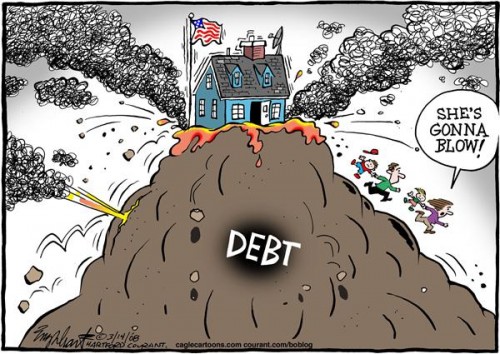
Tuesday, 16 August 2011

Debt Worries, Unusual Problems- Unusual Solutions..


Since 2008, when the economic ills were being treated with generous does of liquidity, the core crisis of debt management was postponed for some time. Now those ghosts of the pasts have come back to haunt those economies.

Visit to any of the European countries, you will realise, how clean the roads are, how well built the infr
astructure is, how well maintained the entire country is. The question that I used to ask everytime is, where do they get such money from? how do they fund these projects? why there are so less people and so many facilities? Tell an European to work overtime (after work hours) & you will find a person scowling. Ask him to pay for his medi-aid and he will scream cruelty.

What they did not realise is that, while creating such benefits for the public, governments used debt route to finance it. These measure did help in increasing the government expenditure, which in turn multiplied the effect on the economy. At the same time, it also created huge liabilities for the governments.

These debts now have become the cornerstone of the current crisis. The governments do not have sufficient monies even to service those debts. They have been over-leveraged.

As the solution for it and they will discuss, how fiscal deficits have ruined the economy. what is not realised is that these deficits were financed to create assets (huge infrastructure), which have no or neglible returns. That was a terrible waste of money. How have they solved it? By pumping more money in the economy, which is again raised by debt.

Now everybody wants to reduce deficits, that too not by raising incomes rather by cutting down the expenditure.... Whatta logic?

You reduce expenditure and that leads to reduction in income (as private investment/expenditure is already in doldrums), this will in turn lead to reduced tax revenues of the government. The government responds by reducing more expenditure. (that's cascading)

After long time, really good move was seen in the markets, i.e. reduction of deficit by combination of reducing expenditure and increasing of revenues. This was done by Italy on August 14, 2011.

Raising revenue is a good option. This was further reiterated by calls from Warren Buffett to increase tax revenues from super rich.

Lets hope, such sense spreads to other European and US economists too. One has to know that you cannot get rich by reducing expenses but by increasing revenues.

Reducing expenses will have multiplier effect on economy. Increased revenues will provide room to governments for maneuvering. Mindless austerity measures will not lead us anywhere, it will just shrink the economy. governments not only need to service their debts, they also need to have planned expenditure.


Saturday, 26 June 2010

Reliance - Shale Cost

Reliance in past two months has made its presence felt in the emerging Shale Gas business with acquisitions of stake in two companies i.e. Atlas Energy Inc for its marcellus shale acres at pennslyvannia and Pioneer Natural Resources Company for its Eagle Ford Shale acreage.
Reliance has always been reluctant to invest in the international markets as they consider them to be more risky propositions. The thumb rule used while investing is the proposed venture should give them returns of average 20% on the investment. In case of the ventures outside India, they expect the returns to be atleast 10% higher considering the additional political risk involved.

Reliance has agreed to pay $1.699 billion for 40% stake in Atlas Energy's venture & $1.315 billion for 45% stake in the Pioneer's venture. the average acreage accrued by Reliance is 1,37,000 acres and 1,18,000 acres respectively. The average cost per acre is around $11,820 together

we will now view these investments in the above mentioned ventures.


Company : Atlas Energy
Venture : Marcellus Shale
Total acreage : 343,000
Reliance Share : 137,000
Total Cost : $ 1699 million
Cash payment : $ 339 million
Balance : $1,360 million (carry arrangement)
period : 4 years (assumed)
Normal cost per acre : $12,401
discounted cost per
acres : $6,309

If we consider reliance will maintain its rate of return of 30% as expected, then the price appears to be far cheaper. further, the company already has 5 wells running and producing around 28 mmcfe per day.


Now lets look at the Pioneer deal:


Company : Pioneer Natural Resources
Venture : Eagle Ford Shale
Total acreage : 289,000
Reliance Share : 118,000
Total Cost : $ 1315 million
Cash payment : $ 263 million
Balance : $1,052 million (carry arrangement)
period : 4 years (assumed)
Normal cost per acre : $11,144
discounted cost per
acre : $5,428


Keeping this analysis, Reliance seemed to have struck bargain.
am still wondering, why markets have not factored in these gains and only looked at absolute investments and not the discounted ones...

Saturday, 15 May 2010

EURO hogwash - Solving problem with a problem

The Greek crisis has the origins in the excessives of the public expenditure without eye on the proportionate returns from it. What does that mean?

It means the exchequer has spent far more than it can afford to do so. That means the government expenditure far exceeds the income it earns. The crisis-because the income now cannot take care of repayments of debt raised for expenditure.

Till this, we understand what is going on. Now what has EURO package proposed?
  1. Balance of Payments facility to Euro members from 60 billion to 110 billion. that means more debt for the governments;
  2. Increasing Euro guarantees upto 440 billion in the form of Euro stabilization fund. where will this come from? from more debt.
  3. Finally IMF facility of additional 250 billion. this is not free aid. but more debt.

So what are we trying to do? we are trying to stave off the debt crisis by having more debt. so that we can roll over the debt. This means we are just trying to postpone the inevitability. But this is with the assumption that growth will return and the governments will have sufficient debt service coverage ratio.

Now what actions are we taking to make higher growth a reality:

  1. Tightening the belts by reducing the expenditure (public). In any country more than 20% of the GDP is directly or indirectly funded by the government. this action will have impact on the GDP of the country (more probably negative)
  2. This will have impact on huge liquidity surge in the markets as countries will be flush with funds (lower cost). This in return will result in high inflation.
Does anybody still think, we are resolving the issue? Comments please...

Friday, 19 September 2008

Biggest international heist in Financial History

Consider This


## Sometime back ##


(a) US denies Dubai Port company to takeover Us Ports company citing security reasons.

(b) Similar voices are heard against chinese companies too (though no official comment on the same)


# Still Sometime Back #


(a) sub prime crisis surfaces.

(b) Lot of financial institutions on shaky ground

(c) Spate of write off follow

(d) Bear stearn crisis, bail out done..

(e) US financial institutions need huge capital to bolster balance sheets.

(f) Fed action follows, credit & liquidity infused. lot of US financial institutions take capital infusion from chinese, Japanese & gulf (basically dubai based) companies.

(though could not verify which gulf company has invested in US Financial institution)

(g) Dollar depreciates, oil rises, world crisis looming.


*** Now ***


(a) US institutions crash

(b) Freddie & Fannie (biggest home mortgage companies) bailed out...

(c) Lehman follows same path.. US refuses bail out

(d) same fate announced for meryll & AIG but bail out package made.

(e) Oil prices decreasing despite hurricanes & Opec announcing reduction in production

(f) Dollar continues to strengthen against currencies

(g) One analyst finds out that biggest unsecured creditors of lehman brothers are Asian institutions!!!!!! (read this article in "from all street journal" in financial daily "mint")


Why?


What is the best way rob anybody?


Borrow---> Spend---> declare bankruptcy----> lender is finished.


Who is better off?


The person on whom the money is spent.

The person who borrows has nothing to lose as he is where he was earlier


Lender is punished...


Did same thing not happen with US markets? Did US government pull out biggest heist in financial history? Who lost most money in this turmoil? borrowers from those insitutions (i.e. US public who may not pay now to the lehman bros) or the ones who had faith in these institutions and lent them huge monies( Asian & other financial institutions)?


Why is dollar appreciating in such situation?

Monday, 27 August 2007

Indo Japan Currency Swap...

India and Japan have entered into currency swap agreement. This agreement specifies that in the event of either country facing currency/forex crisis can swap local currency for dollars with the other country. That means, if any BOP or forex crisis arises for India, then Japan will buy Indian Rupee and sell Dollars to India and vice-a-versa.

Japan has entered into similar arrangements with other asian countries also. In the current scenario, the deal does not have any importance as almost all the asian countries are holding huge forex. But the significance of deal will realised in the event, crisis like that of Asian Financial crisis in 1997 and recent Indonesian forex woes.

Currently Chinese Remnibi is gaining ground and along with that inflation is also galloping in china, this could lead to adverse effect on chinese trade surplus (nevertheless china is experience huge upsurge in its trade surplus---thanks to artifical limit on chinese yuan)
Inflation in china may lead to increase in demand for imported goods vis-a-vis home manufactured goods.

anyways, if that happens, that would mean good days for Indian products as the cost advantage of chinese products may get eroded. The current inflation ion china is around 7%.